

- How to Evaluate a High School Career Academy Pathway
- Start with the student’s actual choice
- Check whether students can change direction
- Separate listed pathways from available pathways
- Treat credentials and college credit as specific promises
- Look closely at work-based learning
- Evaluate the staffing and facilities behind the program
- Test the strength of each partnership
- Find out how the program is funded
- Use a comparison table before making a decision
- Decide what the evidence supports
- What to do next
How to Evaluate a High School Career Academy Pathway
A high school career academy can offer a clearer connection between classes, career interests, college options, and work-based learning. But an academy name or a long pathway list does not tell a family what a student can actually access.
Before choosing a pathway, students and families should verify five things: when the choice is made, whether it can change, what courses and credentials are available, how work-based learning is arranged, and whether the schedule works with transportation and other responsibilities. District leaders considering a similar model need a wider review of staffing, facilities, partnerships, funding, and outcome measurement.
Manchester High School is used here as a point of reference because the proposed review concerns its reported career academy redesign. The available material for this article does not include official Manchester Public Schools documents confirming the number of academies, pathway offerings, launch timeline, funding source, enrollment, partnerships, or results. Those details should be checked against current district, board, state, and program records before anyone treats the redesign as a documented model.
The practical judgment, based on the information available for this review, is not sufficiently documented for replication. That is not a judgment about the quality of the school’s work. It means the evidence needed to evaluate access, partner strength, credentials, and long-term funding has not been supplied.
Start with the student’s actual choice

A pathway is useful only if a student can enter it, complete the required courses, and receive the opportunities described by the school. A published list does not answer those questions by itself.
Families should begin with the selection process. A school might introduce pathways through an exploration course, an interest survey, course registration, an application, or another local process. These arrangements are not interchangeable.
An exploration course may give students time to compare options before choosing. An application may involve eligibility rules or limited seats. Course registration may depend on the master schedule and whether enough students enroll. The current student handbook, course catalog, counseling materials, or pathway coordinator should explain which process applies.
The timing deserves equal attention. Ask:
- In which grade does a student choose?
- Is the choice made before or after introductory courses?
- Does the student select one pathway or several areas of interest?
- Is a parent or guardian signature required?
- Are there deadlines?
- What happens if a student transfers into the school after the usual selection period?
A ninth-grade decision can feel very different from a later choice made after students have taken electives. The school should explain the decision in plain language, especially if the selection affects later course access.
Check whether students can change direction
Career interests often develop through experience. A student may discover that an expected field is not a good fit, become interested in a different subject, or need a schedule that supports other graduation requirements.
Ask whether students can change pathways and what that process involves. The key details include:
- the deadline for requesting a change
- whether approval is required
- whether seats are available in the new pathway
- which completed courses will count
- whether changing could delay graduation
- whether a student may return to the original pathway
A flexible model does not mean every change will be easy or available. A pathway may have limited seats, courses offered only once a year, or prerequisites that make a late switch difficult. Those limits should be explained before a student commits.
If a school does not allow changes after a particular grade, families should receive that information before registration. A pathway choice should not be presented as open-ended if the practical rules make it difficult to leave.
Separate listed pathways from available pathways
A district may describe a broad program while offering only some courses in a particular year. That can happen when a pathway is being introduced gradually, when specialized staff are unavailable, when enrollment is too small to run a course, or when a partner can accept only a limited number of students.
Those possibilities should not be assumed to apply to Manchester High School without current documentation. They are questions any family or district should ask.
For each pathway, request answers to these questions:
- Is the pathway operating during the current school year?
- Which courses are offered now?
- Are any courses planned for a later year?
- Are there enrollment minimums or maximums?
- Are required courses available during more than one period?
- Are students who transfer in able to complete the sequence?
- Are advanced courses available, or does the pathway end after introductory classes?
The answers reveal whether a pathway is a complete sequence or simply a theme attached to a few electives. A student needs to know what can be taken, when it can be taken, and what happens if a required class conflicts with another graduation requirement.
Treat credentials and college credit as specific promises

“Credential,” “certificate,” and “college credit” can describe different opportunities. Families should ask for the exact name of the award, the organization that issues it, the requirements for earning it, and the settings where it is recognized.
A school should also distinguish between:
- completing a career-focused course
- passing an industry examination
- earning an industry-issued credential
- completing a college course
- receiving credit that another college may or may not accept
For dual enrollment, ask which college awards the credit and whether students receive an official transcript. Recognition outside the original institution may vary, so students should check the policies of colleges they may attend rather than assume that all credit transfers.
The same caution applies to industry credentials. A credential may be useful for a particular employer or sector, but its value depends on the issuing organization and the requirements attached to it. The school should identify whether students need an examination, a certain number of course hours, work experience, or another condition.
A useful family question is: What will the student have in hand at the end of the pathway, and who specifically recognizes it?
Look closely at work-based learning
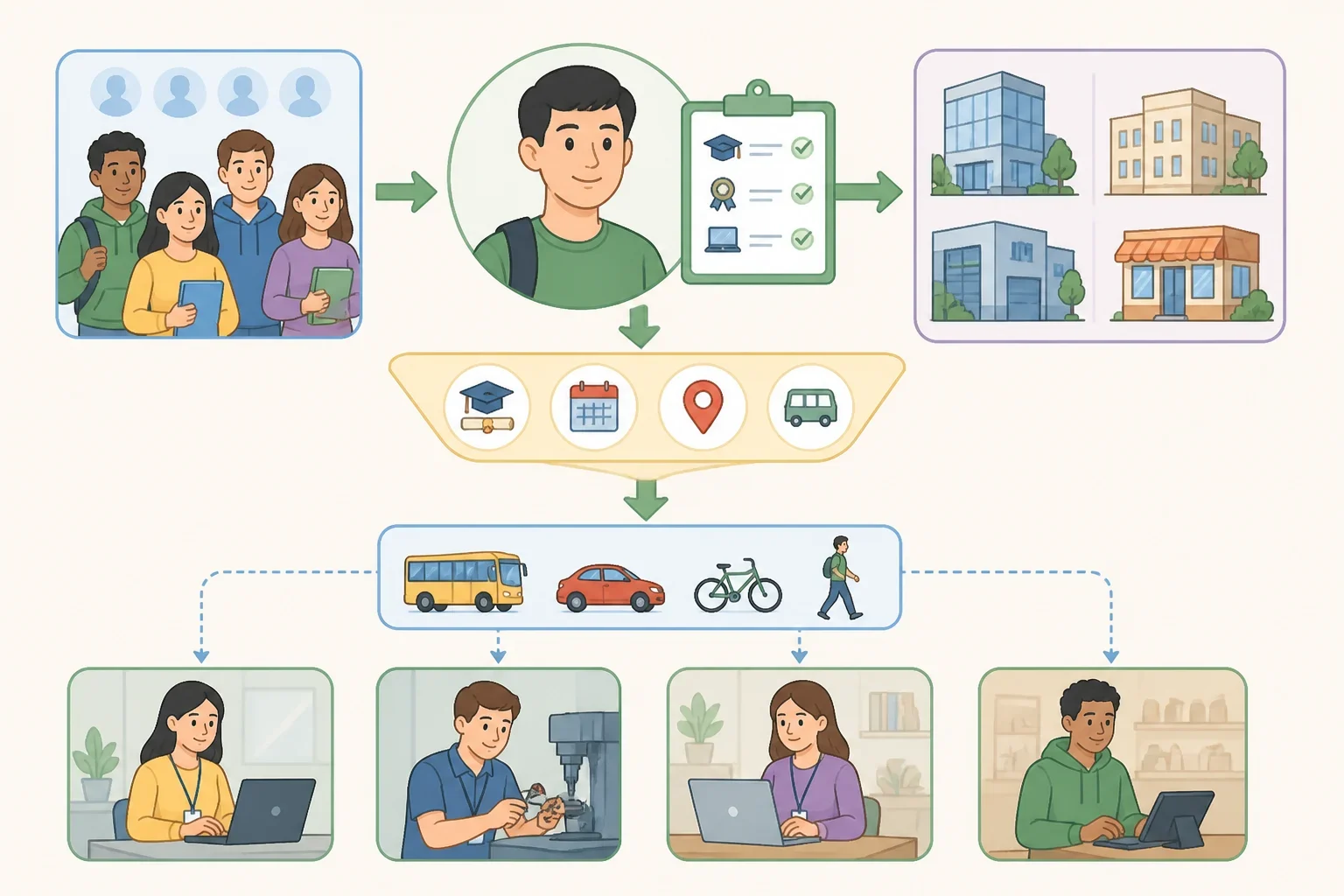
Work-based learning can include internships, job shadowing, mentorship, clinical experience, employer projects, site visits, or another school-approved activity. These options should be described separately rather than grouped under one broad label.
Ask:
- Is the opportunity available to every interested student?
- How many placements are available?
- Who selects students if demand exceeds the number of places?
- Does the activity occur during the school day?
- Are students required to travel off campus?
- Who arranges transportation?
- Are there age, attendance, course, or academic requirements?
- What happens if an employer withdraws?
- Can a student complete the pathway without receiving a placement?
An internship should not be treated as guaranteed merely because it appears in a pathway description. A district may offer work-based learning while having fewer placements than interested students. The school should state whether placement is guaranteed, competitive, dependent on availability, or optional.
Transportation is part of access. A student may be interested in an off-campus opportunity but unable to reach it during the required hours. Families should ask whether the school provides transportation, whether public transportation is practical, and whether the schedule creates conflicts with required classes, caregiving, employment, athletics, or other responsibilities.
Evaluate the staffing and facilities behind the program
A career academy is a course and support system, not only a set of names. Before another district copies the structure, it should identify what resources make each pathway possible.
The review should cover:
- specialized teachers and required qualifications
- counselors or pathway coordinators
- work-based learning staff
- laboratories, studios, or technical classrooms
- equipment and software
- safety procedures and maintenance
- transportation for off-site activities
- time for teachers to coordinate with employers and colleges
These are questions for investigation, not assumptions about Manchester High School. A district may have strong facilities but limited staffing, or experienced staff but inadequate equipment. Either gap can reduce the number of students who can participate.
Staffing also needs a sustainability check. If a teacher takes on pathway coordination in addition to existing duties, the district should explain how that work is supported. If a program depends on one staff member or one partner, families and district leaders should know what happens when that person leaves or the partnership changes.
Test the strength of each partnership
The word “partner” can describe several different relationships. A business may advise on curriculum, provide equipment, host a visit, offer mentorship, or accept students for placements. A college may help design a course, provide an instructor, or award dual-enrollment credit. These contributions have different effects on students.
For every named partner, request a written description of:
- the partner’s role
- the number of students served
- the activities provided
- the length of the commitment
- the staff members responsible
- any student eligibility requirements
- the process for renewing or ending the relationship
A public announcement alone may not explain how students benefit. A company’s participation on an advisory committee is useful, but it is not the same as offering internships. A college connection may support curriculum planning, but it is not automatically a promise of transferable credit.
The question for families is practical: What will this partnership allow the student to do that the school could not provide on its own?
Find out how the program is funded
Startup money and ongoing money serve different purposes. A district may use temporary funding for planning, equipment, renovations, or initial staffing. Recurring expenses can include salaries, transportation, equipment replacement, software, maintenance, and partnership coordination.
A district evaluating a career academy should request a funding breakdown that identifies:
- startup funding
- recurring district funding
- grants or temporary allocations
- equipment and facility costs
- staff positions
- transportation costs
- the period covered by each funding source
A grant can help launch a program without paying for every expense in later years. That does not make the grant ineffective, but it does affect whether another district can reproduce the model and whether the original program can maintain the same level of service.
The most useful budget question is not simply, “How much money was available?” It is, “Which costs continue after the initial funding ends, and where will that money come from?”
Use a comparison table before making a decision

Families and district leaders can organize the review in a simple table.
Question Evidence to request Why it matters Are advertised pathways operating now? Current course catalog, pathway schedule, and seat information Shows whether the listed options are accessible Can students change pathways? Written switching rules, deadlines, and prerequisite information Shows how much flexibility students have What credential or credit is earned? Credential name, issuing organization, college transcript policy, or agreement Prevents families from assuming recognition Is work-based learning guaranteed? Placement policy, number of slots, and eligibility rules Separates an available opportunity from a guaranteed one What transportation is required? Schedule, location, and transportation plan Helps families identify practical barriers Who staffs the pathway? Staff roles, qualifications, and coordinator responsibilities Shows whether the program has the people to operate How are partnerships defined? Written agreements or partner descriptions Clarifies what businesses and colleges actually provide How is the program funded? Budget documents and grant terms Shows whether the model can continue What will be measured? Evaluation plan and reporting timeline Separates participation from longer-term results
This table should support questions, not replace conversations with the school. A counselor or pathway coordinator can explain local rules that may not appear in a general program description.
Decide what the evidence supports
A career academy redesign can be placed into one of three practical categories:
- Documented and operating: Current records show available pathways, defined student access, active partnerships, identified credentials, ongoing funding, and a plan to report results.
- Promising but not yet measurable: The structure and early participation are documented, but longer-term results or capacity information are still developing.
- Not sufficiently documented for replication: The district-specific claims, pathway access rules, partner commitments, funding plan, or evaluation process cannot yet be verified.
Based on the material available for this review, Manchester’s reported redesign belongs in the third category for outside districts considering replication. The classification reflects missing documentation, not a conclusion that the program is unsuccessful.
That distinction protects families from making decisions based on a pathway count alone. It also gives district leaders a useful standard: before adopting a similar model, verify the student experience, not just the organizational chart.
What to do next
Families considering a pathway at Manchester High School should ask the counselor:
- When does pathway selection occur?
- Can a student switch, and what is the deadline?
- Which courses are available during the 2026–27 school year?
- What credential or college credit can the student earn?
- Who recognizes that credential or credit?
- Is work-based learning guaranteed or limited by placement capacity?
- What transportation and schedule requirements apply?
Educators and administrators elsewhere should request current pathway capacity data, written partnership information, a funding breakdown, and an outcome-reporting plan before proposing a similar redesign.
The central decision is straightforward: do the records show real access, useful credentials and partnerships, and funding that can support the program over time? Until those three conditions are documented, a career academy should be treated as a model to investigate, not one to copy.