
- College students' trust in university leadership lags
- Why policy approval and trust in leadership aren't the same thing
- How campus trust compares with views of state and federal policy
- Student perceptions of college leadership shift by politics and school ranking
- What to check before you draw conclusions about your own school
College students' trust in university leadership lags
Ask college students whether they like what their school's leadership has done lately, and most say yes. Ask whether that same leadership is actually looking out for them, and the answer gets more complicated. A national poll finds that college students' trust in university leadership sits well below their approval of specific policies: 79% of students approve of the policies and proposals their campus leaders have implemented, but only 55% say leadership acts in students' best interests all (12%) or most (43%) of the time (Gallup, last week).
That's a narrow majority, not a rejection, and the distinction matters. The poll doesn't ask whether students like their leaders personally or speculate about motives. It asks something narrower: how often does this administration make decisions that serve students? A little over four in ten students aren't convinced the answer is "usually."
The findings come from the Lumina Foundation-Gallup 2026 State of Higher Education Study, based on web survey responses from 3,801 currently enrolled associate and bachelor's degree students ages 18 to 59, collected in October 2025 (Gallup, last week). Gallup frames the split as more than a curiosity. National confidence in higher education overall sits 19 percentage points lower in 2026 than it did a decade ago, and the organization argues that closing that gap will require rebuilding trust among the people who know colleges best: the students actually enrolled in them (Gallup, last week).
This survey measures something specific, what students think of the decisions their own school's leadership makes. It doesn't measure how that leadership compares to peer institutions, and it doesn't explain why students feel the way they do. Keep that distinction in mind for every number that follows. This piece breaks down the approval-versus-trust split, compares it with how students view state and federal policy, looks at how political identity and school ranking shift the numbers, and closes with questions worth asking at your own institution before drawing conclusions from a national average.
Why policy approval and trust in leadership aren't the same thing

A majority of students, 55%, say their school's leadership usually makes decisions that serve students, while the remaining 45% have real reservations (Gallup, last week). Inside that 45%, 35% say leadership acts in their interest only "some of the time," and 11% say "rarely" or "never" (Gallup, last week).
Meanwhile, 79% of the same students approve of the specific policies and proposals their leadership has actually put into place (Gallup, last week). Put those two numbers side by side and a pattern shows up: students are considerably more comfortable evaluating a single decision than they are trusting the process, or the people, behind it.
Picture what that split might look like on an actual campus. A student could support a tuition freeze, a new safety policy, or a change to registration deadlines and still wonder whether the reasoning behind the next decision will hold up. Those are hypothetical examples, not findings from the survey, but they illustrate a real distinction: agreeing with an outcome isn't the same as trusting the process that produced it.
Gallup's own analysis points to one possible consequence of that gap. The organization suggests that the disconnect between how much students value their degree and how much they trust the administration behind it may be shaping negative perceptions of college among students' friends, family members, and peers (Gallup, last week).
Separate research on what scholars call student-institution distrust helps explain why that split deserves attention beyond a single survey question. A study published in the journal Administrative Sciences earlier this year examined distrust among 600 undergraduate business and tourism students at public universities in Saudi Arabia, and found that institutional practices, perceived support, and students' sense of whether their program was worth the cost all predicted how much they distrusted school leadership (Administrative Sciences, earlier this year). That distrust was in turn linked to weaker feelings of belonging, lower academic engagement, and less willingness to ask for help when students needed it (Administrative Sciences, earlier this year).
That research covers a different student population in a different country, so it can't explain the Gallup numbers directly. It does suggest, though, that this kind of doubt isn't just an abstract survey response. Where it takes hold, it tends to show up in how connected students feel to their program and whether they reach out when something goes wrong.
How campus trust compares with views of state and federal policy
Campus leadership isn't the only authority shaping student experience. Most students, 58%, say state or federal policy has changed their campus "a great deal" (14%) or "a moderate amount" (44%), so outside policymaking is a visible part of daily life on most campuses, not background noise (Gallup, last week).
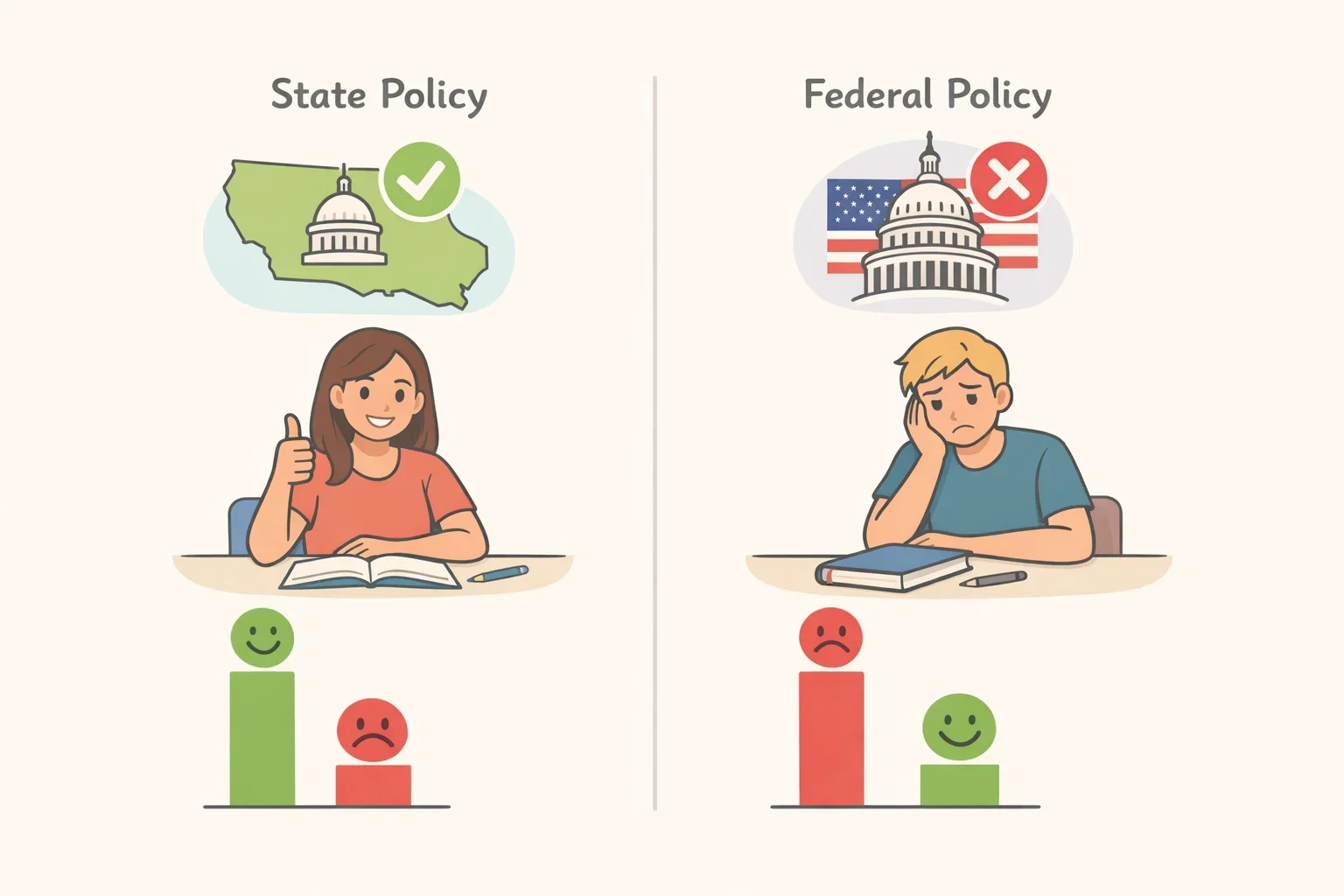
Among students who said their campus had been affected by state policy, 56% approve of those policies and 44% disapprove (Gallup, last week). Federal policy fares worse. Among that same affected group, only 45% approve of its impact on their campus, while 55% disapprove (Gallup, last week).
Campus leadership's 79% approval figure looks stronger than both by comparison, but the comparison isn't clean. That number reflects every surveyed student, not just those who reported being affected by outside policy, so it's measuring a broader group answering a somewhat different question (Gallup, last week).
One pattern holds up even with that caveat: students rate their own school's decisions more favorably than they rate decisions coming from outside government. The survey doesn't say why, whether campus policy feels closer to home, carries lower stakes, or simply comes from people students can picture making the call. That gap is worth noticing, not explaining away.
Student perceptions of college leadership shift by politics and school ranking
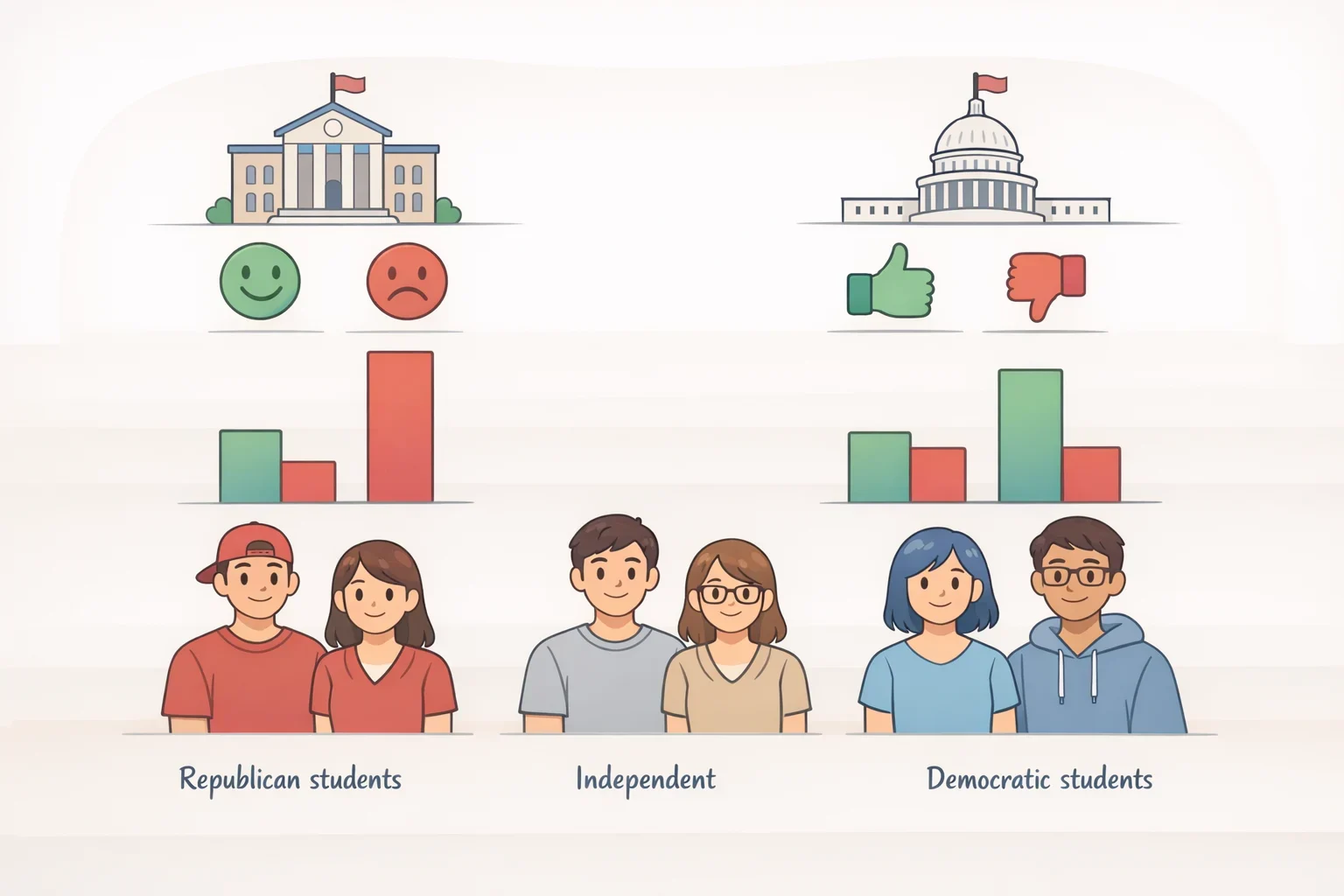
Political identity clearly shapes how students judge policies that come from outside their campus. Republican students are the most likely of any group to trust their school to act in their interest: 62% say their institution's leadership usually acts in students' best interests, compared with 55% of Democratic students and 50% of independent students (Gallup, last week). That's a 12-point spread between the highest and lowest groups.
On federal policy, the same partisan divide nearly triples. Seventy percent of Republican students approve of federal policies affecting their campus, compared with 36% of Democratic students and 38% of independent students, a 34-point spread (Gallup, last week).
Approval of campus leadership's own policies stays comparatively close across those same groups: 86% among Republicans, 79% among independents, and 76% among Democrats (Higher Ed Dive, last week). Students appear to be judging their own school's decisions on different terms than they judge decisions coming out of Washington, where political identity does far more of the work.
School ranking tells a separate story. Reporting on the same poll found that students attending schools ranked in the top 100 of U.S. News & World Report's National Universities list were less likely than students overall to say leaders act in their best interest (Higher Ed Dive, last week). Specifically, 45% of students at those top-ranked schools said they trust leaders to act in their best interest "most of the time," compared with the 55% figure nationally that combines "all of the time" and "most of the time" responses (Higher Ed Dive, last week; Gallup, last week). Those two figures aren't measuring the exact same response option, so the gap between them shouldn't be read as precise. Still, the direction is clear enough: trust runs lower at these institutions than across the sector as a whole.
Students at top-100 schools also report more exposure to outside policy pressure. Nearly seven in ten of them say government policy has affected their campus at least moderately, compared with 58% of students overall (Gallup, last week). Heavier policy exposure, more media scrutiny, higher expectations at selective schools, something specific to large research universities: any of these could explain the lower trust numbers, and the survey doesn't test which one it is.
What to check before you draw conclusions about your own school

None of these numbers tell you whether your own college's leadership is trustworthy. National averages describe a sector, not a single campus, and policies, feedback channels, and governance practices vary widely from one institution to the next. Treat this data as context for a conversation, not a verdict on your school.
The next time your college announces a policy you have an opinion about, whether it's tuition, a new academic requirement, or a change to campus safety, there's a more useful move than simply deciding whether you approve. A short set of questions can tell you more about how the decision was made than any national survey number:
- Find the published rationale. Most colleges post the reasoning behind major policy changes on the provost's, president's, or board of trustees' website. Check whether that explanation actually addresses the concerns students raised.
- Identify who had formal authority over the decision. Was it the board of trustees, a president or chancellor, a dean, or a faculty committee? That tells you exactly who to contact with follow-up questions.
- Check for a public record of student input. Look for student government meeting minutes, public comment periods, or consultation summaries tied to the decision. Their presence, or their absence, tells you something concrete about the process, even if it doesn't settle whether the outcome was fair.
- Ask how feedback shaped the final decision. Contact your student government representative or the dean of students' office and ask directly whether student input changed anything, and if so, what.
- Find the office responsible for implementation or appeals. If the policy affects you directly, know which office to contact if something doesn't happen the way it was described.
A published process isn't proof that leadership is acting in students' best interests, and it won't resolve the national question this survey raises. But it gives you something a survey average can't: a specific, checkable answer about your own school, from the people who actually made the call.