


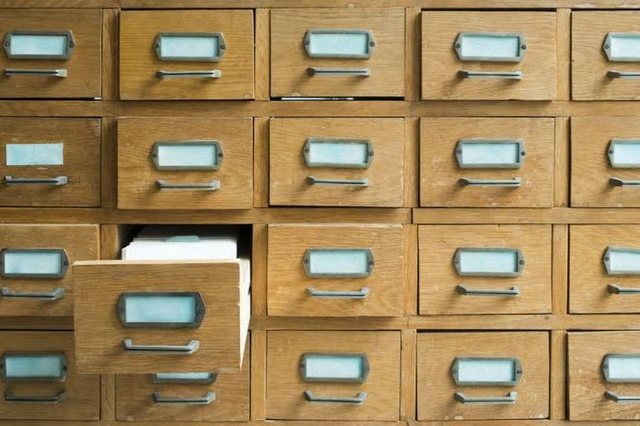
Most original hardcopy card catalogs, often spelled "card catalogues," at public and university libraries have been replaced with a current online version known as the Online Public Access Catalog (OPAC). However, some libraries keep their card catalogs, or portions of them, to help patrons find books and reference materials. Card catalogs are especially useful for cross-referencing older books and journals that are no longer in print.
Subject, Author and Periodical Searches
Use a card catalog to perform subject searches. Robust card catalogs contain approximately 450 main subject headings, such as "music," "law," "agriculture" and "biography," according to The Harvard Crimson. Find general works, such as books, in each category by the author's name -- the first subheading next to the subject. Locate more specific works, such as dictionaries, periodicals, journals and society reports, following the general works. Start with the most specific heading you can think of, and broaden your search if you can't find exactly what you're looking for, recommends the Ohio Reference Excellence.
Indirect Subject Subheadings
Locate more information on the subject if the word "Indirect" -- in parentheses -- is next to the subject. The term "Indirect" means that there are other closely related subheadings. For example, if you're looking for information on "Rodeos," you'll likely find the letters "sa" for "see also" next to the subject, including topics such as "Rodeo clowns," "Trick riding" and "Women in rodeos." Or, you might find the letters "xx" for "broader headings at the next level of specificity," including topics such as "Cowboys," "Horse sports" and "Western riding," according to the University Library at the University of Illinois.
General Search Information
Ignore articles -- "a," "an" and "the" -- at the beginning of a book or reference material when searching the catalog. Words are alphabetized according to their exact spelling. Look for books and subjects that start with initials or acronyms using the first letter of the abbreviation, also filed in alphabetical order. Find identical words in order by author, subject and title.
For example, Music Antonio Zoran, 1909-2005 (author) is followed by Music (general subject) and Music at Midnight by Muriel Draper (title), according to the University of Illinois.
Each card that lists a specific book also contains the publisher, publication date, place of publication and the number of pages.
Library Location
Look at the numbers and letters in the top left-hand corner of the card to locate the book or reference material in the library. Go to the nonfiction section if the record starts with numbers, such as 370.1, for a book on education in the social sciences section. Look for books in numeric order according to the call number. Or, go to the fiction section if the record starts with capital letters -- an abbreviation for the author's last name -- such as "SEN" for Maurice Sendak. Fiction is filed by the author's last name in alphabetical order.