
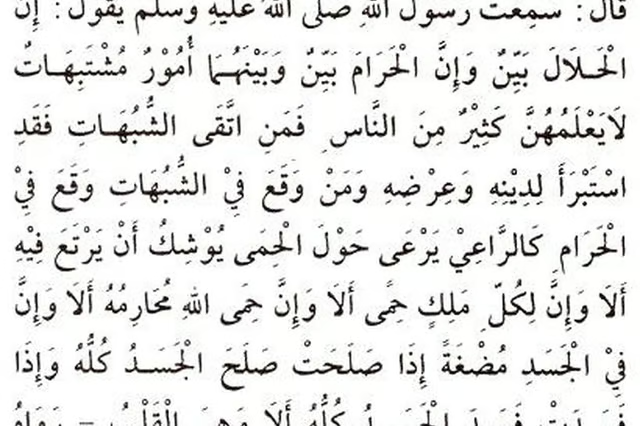
One of the biggest challenges when learning Arabic is mastering sentence structure. Unlike many European languages, Arabic's structure is not at all similar to English. Word order, parts of speech and grammar are all different. While this aspect of Arabic can be difficult, it is not impossible to learn how to compose and read Arabic sentences. Once you learn how to understand the sentences, you will find it much easier to understand and use Arabic in both writing and speaking.
Steps to Learn Arabic Sentences
Learn the Arabic alphabet. You need to be able to read the Arabic letters before you can dissect and understand a sentence.
Familiarize yourself with the parts of speech in Arabic. In addition to the nouns, pronouns, adjectives, adverbs and verbs found in English, Arabic has some additional parts of speech, such as the idaafa.
Learn to recognize typical word order. In Arabic, sentences often begin with the verb. The conjugation of this verb indicates the subject of the sentence, a noun which can be found anywhere later in the sentence.
Differentiate between verbal and nominal sentences. Verbal sentences begin with a verb, as described in the previous step. Nominal sentences begin with a noun or pronoun and are usually employed for sentences with the verb "to be."
Watch for the "idaafa." Arabic uses this grammatical form often to indicate possession and sometimes for other purposes as well. The idaafa typically consists of two or more nouns that are followed by any appropriate adjectives. There are specific grammatical rules to be followed for words included in the idaafa.
Look for the diacritical markings, the fatha, kasra and damma. These indicate the case of each word in a sentence and can be used to enhance your understanding of the sentence.
Tip
The verb "to be" is generally omitted in sentences written in the present tense. In such sentences, the verb is implied and not written. "To be" is used for sentences in the past or future tenses.
Warning
Pronouns are often implied by the verb conjugation and are not written in many Arabic sentences. It is thus possible that there is no subject explicitly present in an Arabic sentence. Most modern Arabic texts do not include the grammatical markings to indicate part of speech, except when absolutely necessary for comprehension. Do not rely on these markings for understanding.