
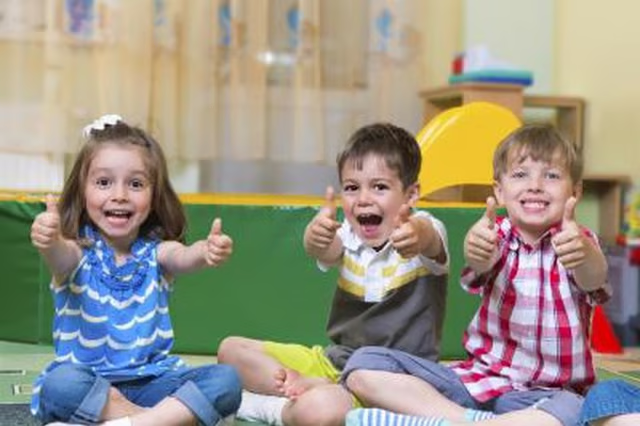
Kindergarten is a time for children to expand their knowledge and love for learning. One way to help develop a child's knowledge is engaging the use of higher level thinking skills. Higher level thinking stimulates children's cognitive abilities and provides them with the skills necessary to become critical thinkers. Teachers can develop and strengthen these skills in the kindergarten classroom through various developmentally appropriate activities.
Memory Matching Games
One way to develop a kindergartener's higher level thinking is by activating his memory skills. In the kindergarten classroom, children can use their memory skills by working either alone or in pairs to play a memory matching games with cards. Memory matching games help stimulate a child's memory by requiring him or her to recall the locations of matching cards. These games help to promote and strengthen short-term memory skills, which are necessary for higher level thinking.
Compare and Contrast
Another key concept in using higher level thinking skills is the ability to use knowledge in a new way. Kindergarteners can use the knowledge that they have obtained in a different way when comparing and contrasting. Be sure to have students explain the similarities and differences between the two objects or ideas. Students can compare and contrast colors, shapes, characters, animals and patterns.
Justifying Opinions
Higher level thinking requires students to develop and justify opinions. Ask students to take a stance "for" or "against" an idea. For example, students could debate whether pigs would make good pets. The class could either be divided -- one side "for," and the other side "against" -- or children could be partnered up for this activity. The most important part of this activity is having students defend their opinions verbally.
Story Discussions
Employ story discussions to help students draw new meaning out of what has been previously learned. Story discussions can take place before and after a story, for example. You can ask questions that require students to make predictions before the story is read. After the story has ended, students can share what they think happened to the characters.