
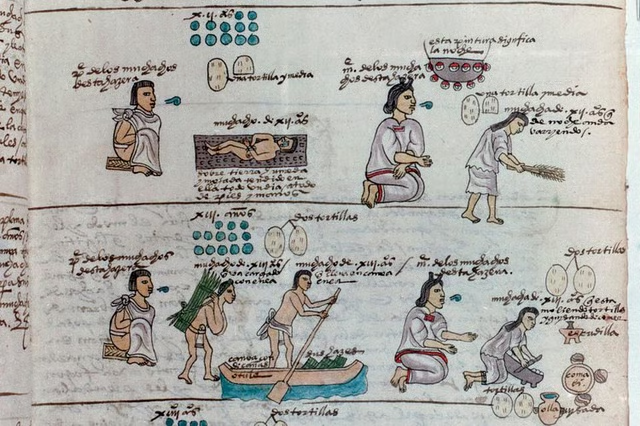


Egyptian hieroglyphics may be the most recognizable but the Aztecs had their own artistic hieroglyph system. Due to the reach of their trade and tribute networks, Aztecs had access to a number of natural pigments. As a result, Aztec hieroglyphics are notable for both their lavish colors and their ability to convey complex ideas through a combination of images. Artists, scribes and even accountants were able to utilize hieroglyphics in how Aztec wrote, conveyed history, transcribed conversations and conducted complex mathematical functions.
Art In Aztec Math
Aztec accountants and scribes would depict a combination of dots, flags, feathers and incense bags to represent specific numbers in the Aztec language. Each image was assigned a set value. A dot was equal to one, a feather equaled 400 and an incense bag represented 8,000. If an Aztec accountant were recording a tribute payment of 440 woven baskets, he would draw a feather and two flags and then connect the numbers with a straight horizontal line. The accountant would also draw a woven basket below the first images before making a short vertical line connecting line to complete the number hieroglyph.
Aztec Language Images
Like many languages, the Aztec Nahuatl often combines different words to express new concepts often in a poetic manner. To illustrate the connection between words, scribes would integrate different images into a single drawing known as a "logogram." For example, the region name for Xochimilco was named after two objects, "xochi-tl," or "flower," and "mil-li," or "sown field." Aztec scribes combined these concepts in their hieroglyphics with a visual representation of that concept. The logogram for "Xochimilco" consists of two flowers growing out of a sown field.
Phonetic Graphics in Aztec Symbols
When Aztec scribes encountered words with no adequate visualization, they would convey these words phonetically. Since they had no written phonetic alphabet in the Aztec writing system, they chose to represent the sounds with images that began with the desired sound in an image called a phonograph. As an example, a phonograph for the word "oztotipac" or "place above the cave," would include the "head of a reptilian earth monster" as Mesoamericans viewed caves as living beings." The Aztecs would then represent the suffix "icpa" with a drawing of yarn, which they called "icpa-tl" in the hieroglyphic Aztec translation.
Ideographic Image Usage
Sometimes, scribes could not find a way to easily convey a word through phonetic or logical means. They then drew ideograms instead. Ideograms represented the idea behind the symbol. A snake might represent the ruler Izcoatl whose name can be translated as "obsidian snake." In other cases, footprints might be used to represent a voyage or the passage of time. This technique was codified to a certain extent to ensure future readers would understand the meaning behind symbols through this hieroglyphic Aztec translation.