
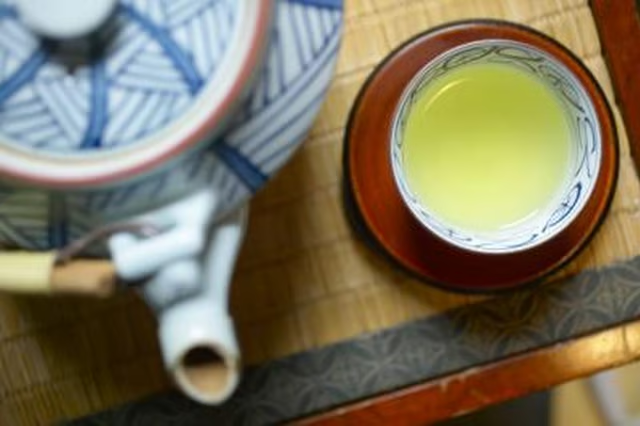
Japan's tradition of producing skillfully crafted tableware grew out of the significance of tea ceremony in Japanese culture. Porcelain tea services imported from China were highly valued for their artistic beauty. By the 16th century, Japanese potters had learned to produce porcelain and within a century were exporting tableware to Europe. In the late 1800s, the Meiji government began trading overseas and Japanese porcelain artists created wares that would appeal to Western markets. Popular Japanese tableware in America during this period included Noritake fine china, Satsuma, dragonware, and Imari ware.
Morimura Brothers and Noritake
The Morimura family of Japan established Nippon Toki Kaisha Ltd. on the island of Honshu in 1904. This company later evolved into Noritake, a major producer of fine porcelain china. The company's first exports of tableware began just after 1914. "Sedan," and "Azalea" are two early floral tableware patterns. Art deco-inspired designs also were popular. Early Noritake china back stamps include the "M in wreath" for Morimura Brothers and a maple leaf with the words "Hand Painted Nippon." Although the word "Nippon," a common English translation of "Japan," was most frequently used by Noritake, it can be found on other pieces of early 1900s china to indicate Japan as the country of origin.
Satsuma Pottery
Satsuma is a type of lightweight pottery that is less delicate than porcelain. Satsuma takes its name from the Kyushu island province where Korean potters started making these wares in the 16th century, primarily for tea ceremony use. Early designs featured flowers and trees, but the style of Satsuma changed several times over the centuries. By the early 1900s, Satsuma was being mass-produced in cities such as Tokyo and tableware was imported to America in large quantities. Favored Satsuma designs included warriors and "immortals," or male figures with halos, and raised white slip decoration called "moriage" was used extensively. Common Satsuma pieces include tea sets, bowls and vases. Marks include painted on or paper labels with Japanese characters.
Enter the Dragonware
Dragonware can be found in both pottery and porcelain and features, as its name implies, a highly-stylized dragon as the central decoration. Japanese potters produced this type of tableware for export from the mid-1800s to about 1950. The dragon is usually shown encircling the plate, saucer, bowl or tea or rice wine cup and occasionally the dragon's head forms the spout on a teapot. Some porcelain dragonware pieces, usually teacups, feature a lithopane in the bottom of the cup, typically of a geisha. Simply-designed pieces of dragonware usually are older and more valuable. These pieces often are unmarked.
True Japanese Tableware
Imari ware is the most widely-used tableware for Japanese cuisine, both in Japan and in America. Although this style of porcelain pottery originated in Arita, the wares are named for the shipping port of Imari. Domestic Imari ware was typically blue and white while export Imari featured vibrant, multi-colored decoration as that was the style favored by western markets. The most well-known producer of Imari porcelain was the Fukagawa family, who established several factories in Arita in the late 1800s. Pieces produced by Fukagawa are signed on the bottom in Japanese characters. Tableware includes trays, plates, bowls and sake sets.