
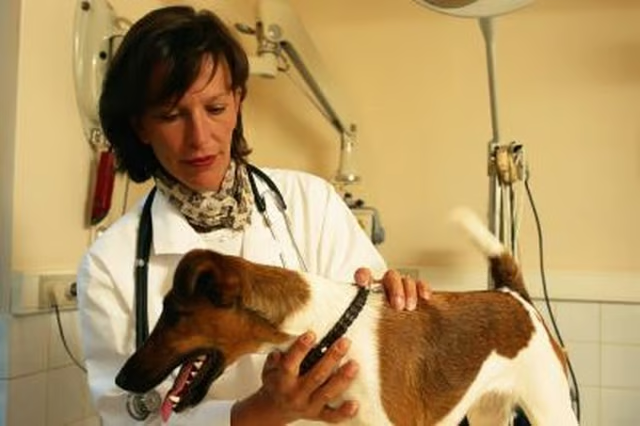


If you're passionate about medicine, veterinary school or medical school might fulfill your interest in the body. You may be able to decide between them based on whether you enjoy working more with animals or people, but the decision may also be made for you based on which type of school accepts you. Although there's some overlap between vet and medical school, there are also significant differences.
Getting In
Some applicants argue that it's more difficult to get into veterinary school than into medical school, which may be a result of the availability of slots. There are only 28 veterinary colleges in the U.S., compared to 141 medical schools. This means you'll have fewer school options if studying veterinary medicine, so you may have to move. If you're pursuing medical school, however, it's likely that a school is located near you.
Prerequisites
While neither veterinary nor medical school require that you choose a specific undergraduate major or have previous experience, you'll still have to meet your school's prerequisite requirements. You'll need a background in life and physical sciences such as biology, chemistry and physics for both types of school, and you will need to have strong math skills, particularly in calculus and statistics. You'll have to go to college to go to veterinary or medical school, but some veterinary schools only require three years of college, which means that you might not have to graduate before enrolling in vet school. You'll have to take the Medical College Admissions Test for medical school and the Graduate Record Examination for veterinary college.
Time to Completion
Both medical and veterinary school typically take four years to complete. After you graduate from medical school, you'll complete a residency during which you master a specialty, but with veterinary school, your residency is incorporated into the time you spend in school. You can, however, choose to specialize in surgery or a similar field, and you may complete a fellowship or additional residency after you graduate. It typically takes slightly longer to become a doctor than it does to become a vet.
Courses
Many of the courses in veterinary and medical school are similar, but doctors learn about people, while vets learn about animals. In both programs, you'll take courses in biochemistry, pharmacology, anatomy and physiology and medical diagnostics. At some veterinary schools, you can specialize in a specific type of animal -- such as exotic animals or wildlife -- while in medical school, you study people more generally. Veterinary school also has a stronger focus on behavioral management, since vets need to be prepared to avoid bites and manage challenging pets.