
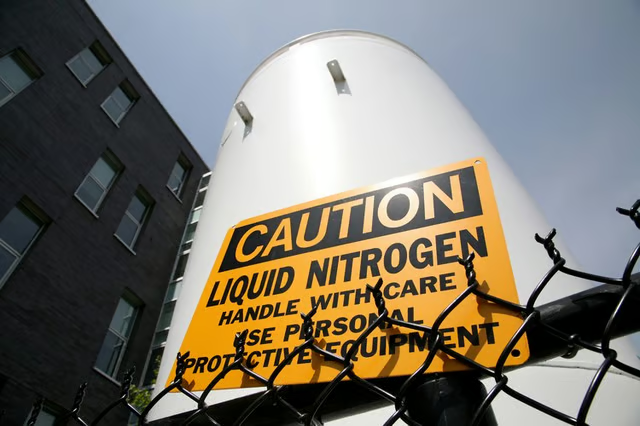
Gases can be cooled and compressed into a smaller volume of liquid. This can be explained by the ideal gas law, V = nR(T/P), where V is volume, nR, for this discussion, is a combined constant, T is temperature, and P is pressure. This equation shows that to decrease V it is necessary to decrease (T/P). The temperature must be lowered and/or the pressure must be raised to liquefy nitrogen.
Critical Temperature and Pressure
Once a sufficiently low (T/P) ratio is reached, the gas changes to liquid. For every temperature, there is a minimum pressure required to establish and maintain the liquid. These are referred to as critical temperatures and pressures.
Nitrogen
At atmospheric pressure, the volume of 28 grams of nitrogen gas is 22.4 liters. The volume of 28 grams of nitrogen liquid is 11.2 liters. Since 11.2 / 22.4 = 0.5, (T/P) = 0.5 as well. If the gas is to be liquefied while maintaining the same temperature, the pressure must be increased, from 1.0 atmosphere to at least 2.0 atmospheres. If, however, the temperature is lowered some, it will not require as great a pressure increase to liquefy the nitrogen gas.