
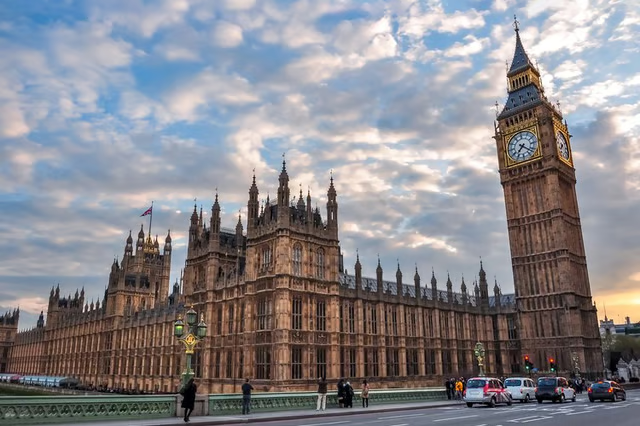
Although Congress and Parliament share some governing similarities, there are distinct differences in each political system. The United States Congress is part of a governing system of checks and balances and includes the House of Representatives and the Senate. Parliament holds supreme power, not relying on such a system of checks and balances. In the United Kingdom, Parliament comprises the House of Commons and the House of the Lords, also relying on the Crown for specific governing duties.
Election Procedures
In the UK, elections are usually held during Parliament’s fourth year, though the Government announces when a particular election will take place. Before disbanding a particular Parliament, the Government must obtain the approval of the Crown. In Parliament, members of the House of Commons are publicly elected, while appointments in the House of the Lords are by the Crown. Congressional elections take place in even numbered years on the Tuesday following the first Monday in November. Individual states establish dates for primary elections, used to select candidates for each political party.
Size Differences
Parliament includes approximately 760 members of the House of Lords and 650 members of the House of Commons. In contrast, the House of Representatives portion of Congress comprises 435 seats. The number of representatives per state depends on individual state population. The Senate is made up of two senators per state, for a total of 100 members.
Responsibilities
Parliament and Congress share similar responsibilities. Congress is responsible for a variety of duties, including making the nation’s laws, approving presidential appointments, impeaching federal officers and distributing public money appropriately. In the United Kingdom, Parliament serves as a legislative body responsible for approving government tax increases, debating various policies, passing laws and scrutinizing the work of the government.
Leadership
Congressional leadership is extensive. In the Senate, the leader elected from the party currently in power is the Senate’s majority leader. The other party elects a minority leader. In the House of Representatives, the Speaker of the House, elected by House members, presides. The House also elects a majority and minority leader, serving individual parties. Other House leadership positions include clerk, sergeant at arms, chief administrative officer and chaplain. Parliament's leadership is also extensive, including the commission, management board, audit committees and serjeant at arms. The Commons also includes a Black Rod representative, an official representing the Queen. The Speaker of the House of Commons is a politically impartial officer. The House of Lords leadership includes Lord Speaker and Lord Chancellor.