
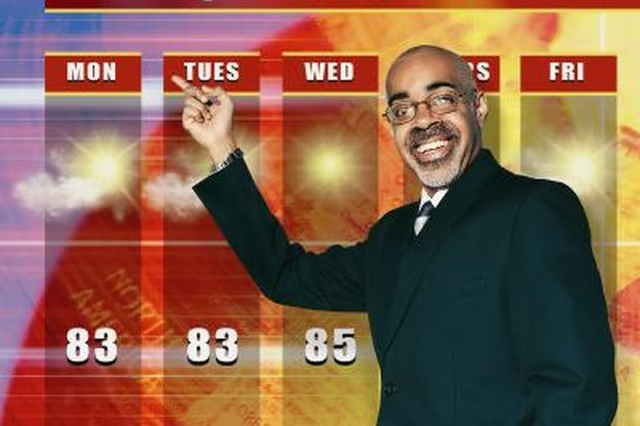
Maybe you dream of forecasting the weather on TV, or perhaps you’re interested in researching global warming or pollution control. Either way, a degree in meteorology or atmospheric science can help you meet these goals. Before earning this degree, however, you need to take a variety of college courses to give you the necessary background and skills to succeed in the field. Science and math classes are necessary, along with several atmospheric science and other meteorology-related courses.
Math Classes
Meteorology is a math-intensive field that requires professionals to analyze qualitative data and use a number of math tools and concepts to interpret information. As such, math classes, particularly courses in calculus, are a required component of all meteorology programs. Anyone interested in working in the field needs to have a strong background in math, starting in high school. Most college programs call for several calculus courses, as well as one or more classes in statistics.
Science
Science classes are another focus in a meteorology program, and physics and chemistry are the primary subjects for meteorology students. Physics courses will explore different aspects of the Earth’s atmosphere, including temperatures and storm formation. Physics also is used in weather forecasting. Chemistry includes the study of atmospheric conditions, as well as thermodynamics and water properties, all of which are important in meteorology.
Meteorology/Atmospheric Science Courses
A number of both required and elective courses will cover meteorology/atmospheric science. Everything from introductory to advanced meteorology classes can be found in college programs. Courses in atmospheric thermodynamics, analysis and forecasting, climate and climate change aim to give students a complete understanding of the subject.
Concentration Classes
Many college programs also offer concentrated studies in specific areas for meteorology students. You may find focuses in broadcasting, air pollution or hydrometeorology. If you decide to take one of these tracks, there will be additional required courses focused on that subarea. For instance, if your goal is to become a TV meteorologist, you’ll need to take classes like television performance and multimedia reporting in addition to meteorology courses. If you prefer a more behind-the-scenes career in research, for example, you could explore fluid dynamics or climate change.