
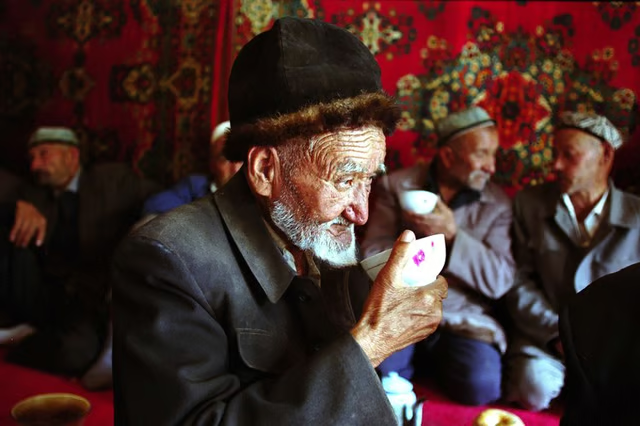
Known as the Silk Road, this vast expanse of intercultural trade routes traversed Eurasia from the Mediterranean all the way to Japan, crossing into India on the way. Textiles, spices and even religions were all exchanged along the Silk Road starting around 1,000 B.C. and continuing for several millenniums. For much of this time, Islam was the dominant religion among Silk Road traders coming from western Eurasia, and they brought with them their belief system and a culture rich in tradition and advancements to millions of people.
Religion
By the 8th century, Muslims stopped thinking of theirs as the "Arab religion" with geographic borders and began seeking converts along the Silk Road. The benefits of conversion to such a widespread religion were many, as Muslims preferred trading with other Muslims. Today the Hui, a Muslim Chinese minority numbering 5 million, are widely thought to be the descendants of Muslim merchants who settled in China at the end of their Silk Road journeys.
Islamic Influence on China and India
In addition to religion, Islamic scientific and medical advancements also had significant impact on Silk Road travelers. Chinese Buddhist traders adopted Islamic medical knowledge in wound healing and urine analysis, according to Johan Elverskog in his book "Buddhism and Islam on the Silk Road." As Muslims traded in India, they also brought with them insights on astronomy including a skepticism of the geocentric universe -- ideas found in Indian science coinciding with a period of heavy Islamic trade from the Silk Road.
Art and Music
While trading along the Silk Road, Muslims developed the first true "global brand" in their production and widespread distribution of exquisite blue and white porcelain. While they most likely borrowed techniques from the Chinese, it was the Muslims who found commercial success as art traders, Elverskog writes. Music was also a chief Islamic export, especially among Sufi Muslims whose holy men or religious storytellers used chanting, singing and instrumental music to win converts from the audiences at the Silk Road's tea houses and bazaars.
Changes in Islam
The cultural interchange of the Silk Road worked both ways, and influences from Buddhist China and other regions affected radical changes in Islam. The most notable change, according to Elverskog, occurred in the 12th century when abstract Islamic art suddenly started depicting human figures, long considered forbidden by Quranic law. It is largely thanks to Muslim artists' experience of Buddhist statues and Indian narrative artwork encountered on the Silk Road that mosques started appearing with representational murals, and Islamic art exploded with new techniques and figures.