
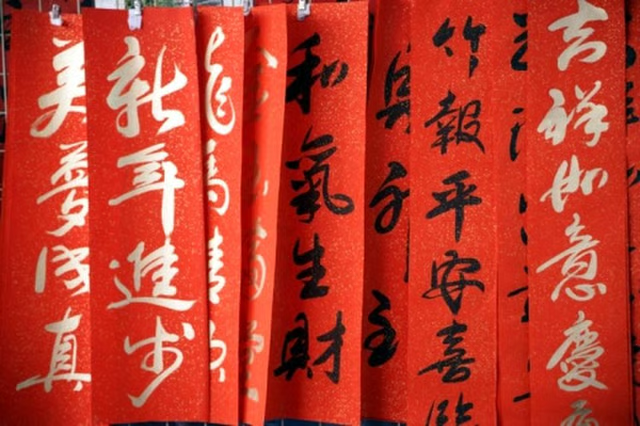


Japanese and Chinese calligraphy share a similar appearance, primarily because the characters used in both originally came from the same writing system. The biggest difference between the two types of calligraphy comes from the differences that developed between the Chinese and Japanese writing systems, though there is also a small stylistic difference.
Reason for the Similarity
A system of writing first developed in China around 1600 B.C.E., during the Shang Dynasty. Chinese characters, while well-suited for elegant calligraphy, lack an alphabet due to their non-phonetic nature. Instead of relying on sounds for meaning, these characters mimic the meaning of a symbol itself. Around A.D. 600, a writing system was developed in Japan. The Japanese initially borrowed the Chinese writing system, but eventually altered the Chinese system to suit its own preferences. As a result of their common origin, however, the two writing systems still have a similar appearance.
Karayou versus Wayou
The manner in which Japanese writers composed works of calligraphy usually followed one of two trends. The first trend goes by the term "karayou" and, like the writing system itself, came from China. Within China this style of calligraphy goes by the term "bokuseki," meaning "traces of ink," and originated during the Tang dynasty in A.D. 618-907. This style of calligraphy, unlike traditionally structured Chinese calligraphy, stems from a free-flowing sense of spiritual detachment from the world. "Wayou," the other popular style of Japanese calligraphy, has its roots in Japanese aesthetics. Wayou references a style of architecture with simple lines, little ornamentation and small enclosed spaces.
Kanji and Hanzi
"Kanji" refers to the Japanese symbols originally borrowed from the Chinese writing system. The Chinese system refers to these characters as "hanzi.". In both the Chinese and Japanese systems, each character can have multiple pronunciations.
Japanese kanji sometimes vary from the original hanzi characters, as the Japanese writing system omitted some of the Chinese characters and simplified others. That said, most kanji characters still have a similar appearance to their hanzi counterparts. The characters may also vary slightly in meaning between Chinese and Japanese writings.
Kana, Hiragana and Katakana
"Kana" refers to the Japanese alphabet created around the eighth century, after kanji had already taken root, and developed in order to satisfy the grammatical elements of the Japanese language. These characters only exist in Japanese writing and calligraphy, not in the Chinese system, and have a phonetic nature. Kana characters also appear softer than most kanji characters.
Two specific types of kana characters exist. "Hiragana," the cursive script, appears most frequently in Japanese calligraphy and was developed to fill the need for grammatical markers and endings. "Katakana," a blocky script, appears less frequently in calligraphy and is usually used to translate foreign or scientific words.