


World War II began in 1939 when Germany invaded Poland. Britain and France responded just day later by declaring war on Germany. It would be a couple of years before the U.S. would officially enter the war, but preparations to provide military air support for Britain in the fight against the Nazis began much earlier.
America Enters the War
Although the power of the Axis countries, those aligned with Germany, grew between 1939 and 1941, it wasn't until the attack on Pearl Harbor on December 7, 1941 that the U.S. became directly involved in the war. As an Axis power, Japan attacked Hawaii on that December morning and the U.S. subsequently declared war on Japan. On December 11th, Italy and Germany declared war on the U.S. Later that same month, President Roosevelt and British Prime Minister Winston Churchill elected to build a U.S. air force presence in England.
The 8th Air Force
In January of 1942, with the U.S. having officially entered the war and collaborating directly with Britain's Royal Air Force, the Allied forces enacted the VIII Bomber Command, a division designed to lead the air attack against Germany directly.
Initial European Attack
While the U.S. would not make an air attack against Germany until 1943, their first European bombing took place on June 12, 1942. Twelve B-24 bombers attacked strategic sites in Ploetsi, Romania. Ploetsi was a confirmed supplier of equipment and oil for the Nazis and would be a regular target throughout the war.
Initial German Attack
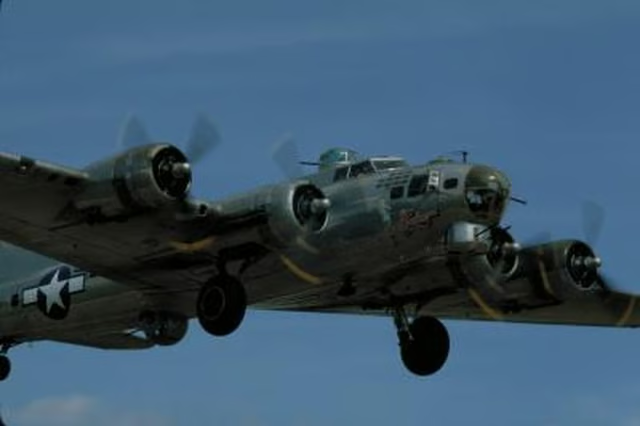
On January 27, 1943, the 8th Air Force sent 64 planes from their base in England in what would be the first U.S. bombing of Germany. Both B-24 bombers and B-17 Flying Fortresses, known for their ability to take heavy fire, began their raid on the German port of Wilhelmshaven. Fifty-three planes managed to hit their targets and shot down 22 German planes. The raid was considered a success, doing significant damage to the infrastructure at Wilhemshaven while only losing three U.S. bombers in the process.
The War Continues
U.S. air support in the war would see many victories and defeats until the war's end in 1945. At different points, the U.S. would bomb German industrial targets during the day while the British continued the onslaught at night, known as the Pointblank directive of 1943. At other times, such as Black Thursday in October of the same year, the U.S. would assume heavy losses, losing 60 B-17 bombers and 600 crewman to heavy anti-aircraft fire. Pilots, crews and planes on both sides would take their most dramatic losses in 1945 in the Battle of the Bulge, where 19,000 Allied troops were lost in the month-long battle. Nevertheless, the Axis powers suffered much greater defeat, sustaining a reported 100,000 casualties.