
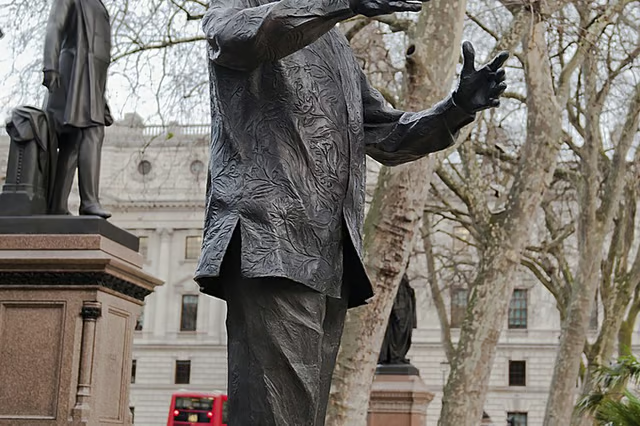
The successful election of President Nelson Mandela in 1994 ensured that apartheid would remain banned in South Africa forever. However, the effects of apartheid, a racially-motivated system that separated white South Africans from non-white counterparts, are difficult to extinguish. Poverty, poor education, corruption and racial prejudice still remain facts of life in a nation recovering from apartheid. South Africans living in the post-apartheid era will need to contend with these effects for decades.
Poverty
South Africa's black majority and Indian minority still earn far less than their white counterparts, even after 20 years of African National Congress rule. Although Mandela started the process of reducing poverty, his successors, Thabo Mbeki and Jacob Zuma, have been extremely ineffective in raising wages for black South Africans, and have seen their administrations wracked by constant scandal. Black South Africans still earn only 10 to 20 percent as much as whites, usually performing menial labor. Two-thirds of South Africans under the age of 25, the vast majority of them black, are unemployed. The vast majority of businesses publicly owned and traded on South Africa's stock exchanges are still owned by whites.
Education
Educational prospects have improved slightly for black South Africans, but many rural areas are still impoverished, and funds are often unavailable for schooling beyond the eighth grade. The Bantu education system, which provided only basic education for black South Africans during apartheid, has been replaced by a public-private system that is notionally equal, but inherently unequal. Enrolling in a South African private school requires an extensive financial investment that most white South Africans can afford, but most black South Africans cannot. Scholarships are available to integrate some of these private schools, but more investment is required for South Africa's public school system.
Corruption
A staple of the apartheid system, corruption never completely left the South African government in the post-apartheid era. Although Mandela did his best to curb corruption, not even he could completely eradicate the kickbacks given to preferred industries such as the mining magnates and the natural resource wars between corporations. Corruption became endemic during the Mbeki and Zuma administrations. Zuma was accused of spending approximately $24 million in public funds on his estate instead of education and public services for his people.
Prejudice
Although apartheid removed the legal barriers for black South Africans, racial prejudice is still a major problem. The South African government published a reconciliation survey in 2012, which found that 43 percent of South Africans never speak to a person of another ethnicity. Only 17 percent of South Africans actively socialize and develop close friendships with people of other races, while the remaining 40 percent will communicate with members of other races, but only on business or formal occasions. In this respect, South Africa still remains a racially divided country that will require at least another 50 years to truly integrate