
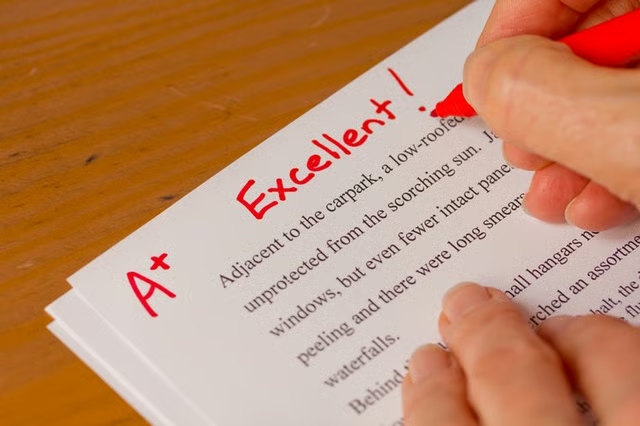


A student’s GPA, or Grade Point Average, is a calculation that averages his grades into a single number that shows where he falls in comparison with the rest of a class. Several things go into calculating GPAs and these factors can have both positive and negative affects on a student’s earned GPA. While every institution calculates GPAs a little bit differently, the following rules generally apply.
Grades
The biggest factor that determines a student’s GPA is grades. The higher grades a student achieves, the higher her GPA will be and vice versa. In the standard grading system, grades A through F are given a number value from 4 to 0, with A being 4 and F being 0. If a student has a 3.0 GPA, earning more As will raise the GPA while earning Cs will lower the GPA.
Honors and AP
Honors and Advanced Placement courses can affect GPAs because they are scored differently. Grades for these courses are given numbers 5 through 1, with an A equaling 5 and an F equaling 1. Even if a student has a perfect 4.0 GPA, getting an A in an honors or AP course can raise the GPA above 4.0.
Plus and Minus
Some schools expand the A-F grading scale by adding plusses and minuses. These additional marks are scored differently in that a plus is worth a third of a point more and a minus is worth a third of a point less. For example, A+ is equal to 4.33 while A- is equal to 3.67.
Credits
The number of credits a course is worth has an affect on how it is scored in a student’s GPA. To calculate GPAs, grades are converted to numbers and numbers are multiplied by the credits the course is worth. As such, courses worth more credits will be weighted more than courses worth fewer credits.
Dropping Classes
Dropping or withdrawing from courses will also affect a student's GPA. While the rules can vary depending on the school, students are generally allowed to withdraw from a course within the first few weeks of the semester. Withdrawing after the deadline will give the student a W in the course, which can be converted to an F if the student was failing the course at the time of withdrawal.