
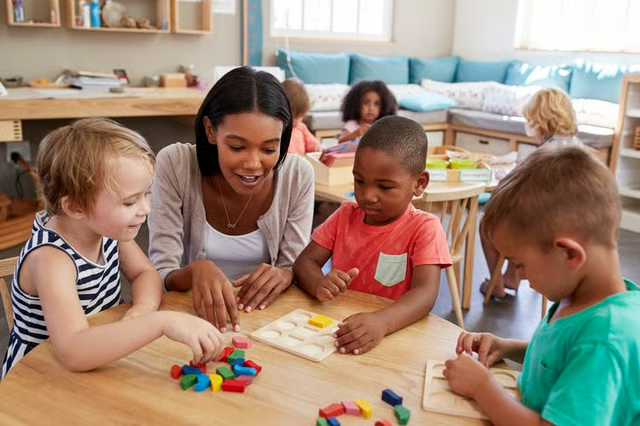


Kindergarten teachers play an integral role in early childhood development by fostering basic intellectual and social foundations. To build these foundations, kindergarten teachers implement several teaching methods that challenge students to express themselves while learning. Successfully teaching kindergarten is about finding the right balance between fun and learning.
Cooperative Learning
Cooperative learning is a teaching method that groups students into pairs or small groups where they are challenged to complete a task. Successful completion of a task is determined how well the pair or group work together. This teaching method promotes peer-to-peer respect and develops understanding of each others interests, skills and needs. Furthermore, it encourages students to take control over their own learning experience by providing ample opportunity for them to express and share their personal concerns, feelings and thoughts. Group tasks in cooperative learning are structured to involve the entire group and can't be completed by only one person. The teacher should monitor group activity and intervene when necessary to clarify instructions and demonstrate good team behavior.
Hands-On Approach
The hands-on approach is a teaching method that encourages students to learn by doing and by example. Using props helps students to learn about abstract concepts, develop critical thinking and solve problems. Teaching students about basic mathematics concepts such as addition and subtraction, for example, might involve the use of board games. Computers also play a role in hands-on learning when students are encouraged to learn a concept through an education game or in an interactive multimedia format. Again, students are encourage to be actively involved in their own education.
Conference Learning
Conference learning is a teaching method that gives a teacher one-on-one time with each student. This works best while the other students are engaged in an activity or play time. The teacher should meet with each student to discuss their difficulties, successes, and interests. These mini-conferences provide a teacher with a better understanding of a student's strengths and interests, which will help tailor lessons, activities and homework to help students thrive. Conferences should happen periodically throughout the year to keep on task and get progress reports which provide information on how to proceed. Furthermore, conferences can take place while children are learning if a teacher individually asks them engaging questions about their work, encouraging them to talk about their approach to the task.
The Play Method
An ideal kindergarten classroom is a safe environment that provides ample opportunity for children to play, which in turn develops confidence and social skills. The first step to play as a teaching method is observation -- then the teacher can structure the play. Teachers should do so without dominating or directing the play, but by sharing the experience with the children and presenting ideas and materials that will help extend the play into a learning experience. If children at play are having an imaginary tea party, for example, the teacher should knock on the door and ask to join, sit at the table and drink imaginary tea. The play is extended when the teacher asks questions about what's being served, introduces new vocabulary and adds ideas.